





We Know We Should Eat Less Sugar. But What Should We Replace It With?

By Mbali Mapholi, Canderel Partner Dietitian
Most of us have heard the advice… “eat less sugar”. But that advice becomes more complicated when we apply it to everyday life. What happens to the two teaspoons of sugar in your morning coffee? The sugar sprinkled over breakfast? The afternoon cup of tea? Or the sugar you routinely add when baking at home?
For many people, the challenge isn’t understanding that they should reduce sugar. It’s knowing how to do it without feeling as though everything they enjoy suddenly has to disappear. As a dietitian, I believe that’s where the conversation needs to become more practical.
Rather than asking people to eliminate sweetness entirely, we should help them understand where sugar enters their diet, what it contributes nutritionally, and where simple substitutions can make a meaningful difference.
Start With the sugar You Add Yourself
The World Health Organization recommends keeping free sugars below 10% of total daily energy intake, with a further reduction to below 5% offering additional health benefits. For someone consuming approximately 2,000 calories per day, that 10% threshold equates to around 50 grams, or roughly 12 teaspoons, of free sugar.
That can sound like a lot. But sugar doesn’t necessarily arrive in 12 teaspoons at once. It accumulates.
Two teaspoons in your morning coffee. Another in your tea. Sugar added to breakfast. Sweetened drinks. Sauces and condiments. And then there are the sugars already added to many of the packaged foods we consume. Individually, these choices can seem insignificant. Collectively, they contribute to our overall free-sugar and energy intake.
This is why I often encourage people to begin with something they can actually control, which is the sugar they add themselves.
Your coffee is a choice. Your tea is a choice. How you sweeten your oats is a choice. The ingredients you use when preparing food at home are choices. These are small decisions, but they happen repeatedly.
What Actually Changes When You Swap Sugar?
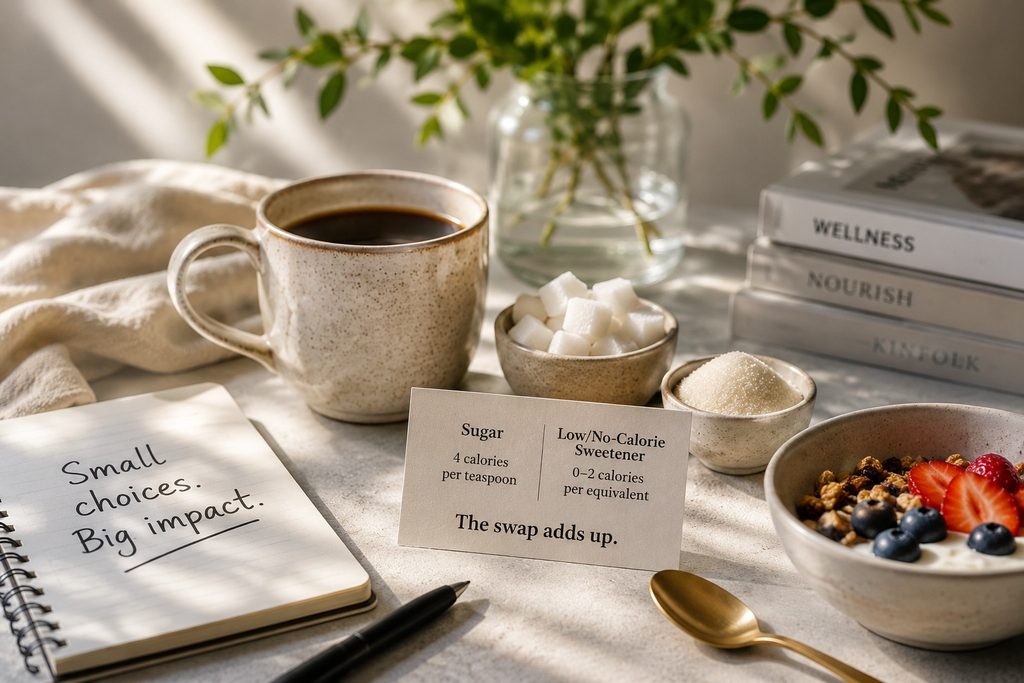
Sugar provides approximately four kilocalories per gram. A standard teaspoon of sugar of around four grams therefore contributes approximately 16 calories. Two teaspoons in a cup of coffee contribute around 32 calories.
Have three similarly sweetened coffees during the day and you’re approaching 100 calories from the sugar in those drinks alone. That doesn’t make coffee with sugar inherently “bad”. But it demonstrates why repeated everyday habits matter.
Many high-intensity sweeteners work differently. Because they provide sweetness at very low concentrations, many contribute little or no energy at the quantities normally consumed. Canderel tablets, for example, provide zero calories per tablet.
So, if someone enjoys sweet coffee, replacing the sugar they would normally add with an appropriate Canderel product can substantially reduce the calories being added through sugar while allowing them to retain the sweetness they enjoy.
And that’s an important distinction. The objective isn’t necessarily to give up the coffee. It’s to look at what you’re putting into it.
Sugar Isn’t Only a Conversation About Calories
Calories are only part of the story. Sugar is a carbohydrate and therefore has a different metabolic effect from many high-intensity sweeteners, which generally provide little or no carbohydrate at the quantities used and typically have much less effect on blood glucose than sucrose. This distinction can be particularly relevant when reducing sugar or carbohydrate intake is a nutritional consideration.
It is also why we need to move beyond treating all things that taste sweet as though they are nutritionally identical.
Sweet taste and metabolic response are not the same thing.
Understanding that allows consumers to make much more informed choices. What About the WHO’s Guidance on Sweeteners?
This is where the conversation requires some nuance. In 2023, the World Health Organization issued guidance advising against using non-sugar sweeteners specifically as a long-term strategy for weight control or reducing the risk of non-communicable diseases.
That recommendation is frequently interpreted as meaning that approved sweeteners are unsafe. That is not what the recommendation says. The WHO guidance on weight management is separate from the toxicological safety assessment of individual sweeteners. Since that guideline was published, the scientific conversation has also continued to evolve, with further research examining what happens when low- and no-calorie sweeteners are used specifically to replace sugar, rather than simply looking at sweetener consumption in isolation.
That distinction matters. The practical question is not whether adding a sweetener to an otherwise unchanged diet magically produces weight loss.
It doesn’t. The more useful question should be; What happens when sugar is actually replaced?
When an appropriate low- or no-calorie sweetener replaces added sugar in a food or beverage, the nutritional composition of that item changes. Depending on the product used, sugar, carbohydrate and/or calorie content can be reduced.
That doesn’t make sweeteners a weight-loss treatment or a substitute for a balanced diet. It makes them one practical tool for sugar reduction.
There Is Another Benefit We Don’t Talk About Enough
Sugar reduction isn’t only relevant to calorie or blood-glucose conversations. Frequent exposure to fermentable sugars is strongly associated with dental caries. Oral bacteria metabolise these sugars and produce acids that contribute to the demineralisation of tooth enamel.
Sweeteners that are not readily fermented by cariogenic bacteria don’t provide the same substrate for acid production as fermentable sugars. That doesn’t make sweeteners a treatment for dental problems, but replacing some fermentable sugars with appropriate non-cariogenic alternatives can form part of a more tooth-friendly dietary approach.
Again, the principle is substitution.
Don’t Try to Change Everything at Once
Nutrition advice can become overwhelming very quickly.
Eat this. Don’t eat that. Count this. Avoid that.
For someone who simply wants to improve their diet, the amount of information can make healthy eating feel unnecessarily complicated.
I prefer starting with a much simpler question: Where is the easiest place in your day to make a better choice?
If you put two teaspoons of sugar in every coffee, start there.
If you add sugar to your oats every morning, look at that.
If your family regularly bakes at home, explore how some of that added sugar could be reduced or substituted.
If you’re consuming large amounts of sugar-sweetened beverages, that’s another obvious place to begin.
You don’t necessarily need to transform your entire diet overnight.
You need to identify the habits you repeat most often.
Sweeteners Are a Tool, Not a Miracle Ingredient
This distinction is important. I would never tell someone that simply replacing sugar with a sweetener makes their entire diet healthy.
It doesn’t. The quality of your overall eating pattern still matters. Fruits and vegetables matter. Fibre matters. Protein matters. Portion sizes matter. Physical activity matters.
But that shouldn’t prevent us from recognising where useful substitutions exist.
Canderel provides different sweetening options that can be used across everyday occasions such as coffee, tea, breakfast, cooking and baking. Their practical role is straightforward: they give consumers an alternative when they want sweetness without adding the same amount of sugar.
For someone actively trying to reduce their sugar intake, that can be useful. Make the Sweet Smart Changes You Can Actually Maintain
The most effective nutrition advice isn’t always the most dramatic. It’s the advice people can realistically follow. If someone drinks three cups of coffee every day, changing how those three coffees are sweetened is a habit that can potentially be maintained for years.
The same principle applies to breakfast, tea, cooking and baking. These individual changes may appear small, but healthy eating is largely built on the choices we repeat.
So instead of beginning with: “What do I need to give up?” I would encourage people to ask: “What can I swap?”
Start with the sugar you add yourself. Understand where the rest of your sugar is coming from. Choose alternate like Canderel, which has low calorie and makes practical sense. And then keep working on the quality of your overall diet. Reducing sugar doesn’t have to mean eliminating sweetness or completely changing the way you eat.
Sometimes, healthier eating starts with something much smaller: One everyday choice, made a little smarter.