






STRESS AND ANXIETY KEEP SMOKERS SMOKING, NEW TESTIMONIES REVEAL

More than 235 smokers and former smokers have shared their experiences as THR Global’s #WeAreTheEvidence campaign puts lived experience at the centre of the tobacco-harm-reduction conversation.
FOR years, the message to smokers has been straightforward: quit. Yet the experiences of hundreds of smokers and former smokers suggest that walking away from cigarettes is rarely that simple.
Insights from THR Global’s #WeAreTheEvidence campaign show that stress, anxiety and depression are among the most cited reasons people start or continue smoking, with 32.8% of participants identifying these factors in their personal journeys.
The finding points to a wider challenge in smoking cessation: wanting to quit does not always translate into success. A South African study involving 18,208 adults found that 74.6% of current combustible smokers had previously attempted to quit, while only 42.8% of those who had tried had ever used a cessation aid.
That gap between intention and success is what THR Global is seeking to better understand.
Through #WeAreTheEvidence, the organisation has documented more than 235 first-hand accounts from smokers and former smokers, capturing why people smoked, what made quitting difficult and the different approaches they used to move away from cigarettes.
The stories show there is no single quitting experience.
Ndaphi began smoking in high school through peer influence and continued for 16 years. Over time, he came to recognise the financial and personal impact of smoking, including the effect it had on those closest to him, before eventually moving away from cigarettes through harm-reduction alternatives.
Laksha’s experience was different. Nicotine pouches did not work for her because they failed to replace the hand-to-mouth behaviour she associated with smoking. During her interview, she also learned how her smoking had affected a friendship, with time together often interrupted by smoke breaks.

These experiences illustrate why THR Global believes smoking cessation cannot be reduced to willpower alone. Stress, behaviour, routines and personal circumstances can all shape a smoker’s ability to quit.
The testimony archive also provides insight into what participants say helped them.
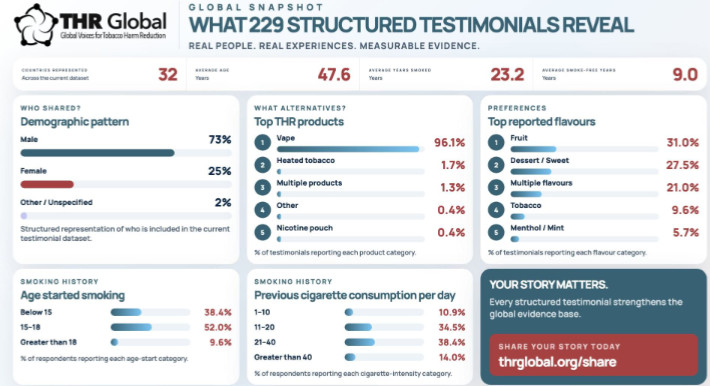
Among THR Global’s first 210 formal testimonials, 95.7% reported using vaping as part of their journey away from cigarettes.
THR Global says these self-reported experiences should not replace clinical evidence but can add important human context to it.
Recent research continues to examine the role of harm-reduction approaches in smoking cessation. The Cochrane review on electronic cigarettes for smoking cessation found high-certainty evidence that nicotine-containing e-cigarettes increased quit rates compared with nicotine-replacement therapy.
A separate 2026 review published in Addiction similarly found that estimates across multiple systematic reviews consistently favoured nicotine-containing e-cigarettes over interventions including nicotine-replacement therapy, non-nicotine e-cigarettes and other forms of support.
Mental wellbeing is another important part of the picture. A systematic review and meta-analysis published in the British Medical Journal found that smoking cessation was associated with improvements in anxiety, depression, stress, psychological quality of life and positive affect.
Taken together, the research and personal testimonies raise a broader question: whose voices are included when decisions about smoking and tobacco harm reduction are made?
For THR Global, people living through these experiences should be part of that conversation.
#WeAreTheEvidence is designed to make lived experience accessible to consumers, researchers, public-health stakeholders, regulators and the media, allowing decision-makers to understand smoking and quitting not only through clinical studies and statistics, but through the experiences of people directly affected.
That call comes as international thinking around tobacco harm reduction continues to evolve. In a 2024 New England Journal of Medicine commentary, Harvard Medical School professor Dr Nancy Rigotti examined whether evidence around electronic cigarettes as cessation tools had reached a “tipping point” for the medical and public-health community.
For THR Global, however, the central argument is not that every smoker needs the same solution. It is that people trying to move away from cigarettes need to be heard.
By putting more than 235 experiences on record, #WeAreTheEvidence is creating a clearer picture of why people smoke, why quitting can be difficult and what smokers themselves say helped them move away from cigarettes.